One Piece at a Time

In an ongoing rally between myself and my good friend SoapBubbles we’re making a concerted effort to boost each others productivity in our various projects. We’ve talked about this in parts during some episodes of The Ourcast and I encourage you to check them out if you have an hour or so to kill and don’t mind two people talk about their lives and futures. We’re not sure where our respective futures will take us but we do know that we want to spend the rest of it creating things for ourselves and others to hopefully derive some joy. We each have documents set up on our Google Drive’s where we can write suggestions for things to help inspire the other to write, it’s not that we don’t have ideas of our own but sometimes it helps to have others expand the scope of your attention.

Immediately after we decided to start doing this Soapy had a list of five or six things up that I need to start working through ASAP. I’m excited to start writing about them and already have the outlines started for a couple but first I just wanted to throw this up because the more I think about it the more important it is that I write down more of my thoughts instead of internalizing them. Otherwise what’s the point of having a blog? A podcast? A Twitter? YouTube? The most challenging thing of this entire endeavor, going back a few years to when I first set up this blog or really became enamored with even trying it is that externalizing all of this doesn’t come naturally. I’m used to having my thoughts on my own, some of them warrant discussion but most of them I consider to not be worth holding on to. If I’ve had that thought surely someone else has had it as well and enunciated it better than I could have anyways, right? The internet is a supremely powerful tool which allows us to find a viewpoint on any opinion we may have or ever have. Over time I’ve discovered that concept can be poisonous to the very nature of creativity. The urge to be standout and unique in the things you do is overwhelming even in the face of it’s near impossibility, that isn’t any reason to not try but it’s also absolutely no reason to not try, either. So with that creative hurdle somewhat cleared and instead just bouncing along dragging behind me like an anchor occasionally catching on some reef or an old sedan, the next one is a matter of habit. Throughout every day, every thing I think or look at and have an opinion on now needs to clear an additional filter before leaving my thoughts forever. Is it worth it write about this? Does anyone care? Do even care? I still don’t have concrete answers to any of that but I guess like with most things this too will become easier with practice, for now I will write about whatever I get my grey matter on and go from there.

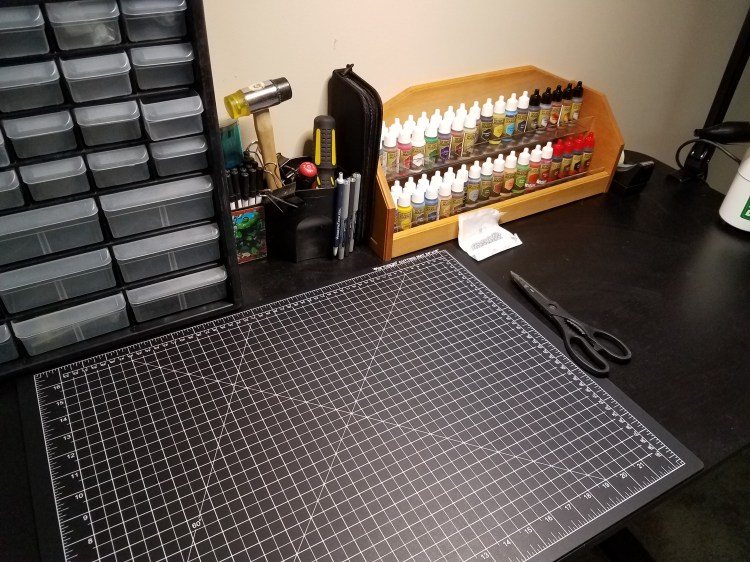
In addition to writing regularly and overall writing more this next week will mark the start of another project I have wanted to get into for some time: Model painting. Specifically minis for games like Dungeons &  Dragons, minis which I have had for well over a decade in some cases, always well meaning about getting around to them but we know how that goes. painting_table

Barring a couple of items this is the setup I’ll be embarking with to learn from the ground up how to paint my mini collection and if everything goes well I’ll be sharing that journey on YouTube through a series of videos. Naturally I’ll post updates about that to this blog as I go as long as things I’m working on that don’t fit into the videos. The first set of minis I’m going to be painting will be from the new game by Fantasy Flight called Star Wars: Legion which I’ve been excited for since it was announced over a year ago, it releases this week on the 22nd. A man who goes by Game Methuselah, or Jim Murphy (Great name, especially after seeing Netflix’s Altered Carbon), recently started his own channel to talk about various table top games, concepts and do videos on model painting. As a Golden Demon Award winning speed painter it’s hard to pass up the opportunity to learn along with him as he ventures into his own new realm of YouTube content creator. He’s a fantastic resource and I encourage everyone to head over and give him a listen! Another resource I’ll be taking advantage of on this path of learning is Sorastro’s Painting guides, specifically the ones on SW: Legion. I’m sure my final product wont be anything up to his standard but they are exceptionally informative which is helpful for a newbie like me. Also, even if you aren’t painter yourself there are just straight up interesting videos to spend a little time watching. Anywho, I’m not what you would call naturally talented at these kinds of artistic pursuits but in one of his recent videos Jim made an excellent point that neither was he until he spent time learning it. Now or never then!

The next post will be on one of the questions SoapBubble was nice enough to provide me with and will naturally be gaming related. She’s given me several fantastic topics to mull over but in the course of writing this I think I’ve decided to tackle the first on the list, has a nice symmetry being that this week will include several firsts.

Is there a game developer that you trust explicitly and will always play their IP’s no matter what? Alternatively if there is no such developer, what are some that have lost your trust and require scrutiny before purchasing?” 

I’ll be organizing my thoughts on this over the next day or two and get it posted shortly after, hope you are well and I’ll be back to talk to you again soon!

  • Non-Washable


Golf Story

      Historically my relationship with the real life game of golf and it’s digital cousins has been something of a contradiction. Growing up less than a few minutes walk to a golf course and working there for several summers as a kid retrieving shanked balls I never grew enamored with the game itself. What isn’t to like about a game that provides a quiet, methodical, and zen like experience to be enjoyed over the course of an afternoon? Assuming you stay out of the water hazards that is. Golf’s video game counterparts hAtari2600Golf.jpgowever I always found myself fascinated by and believe it or not that started way back with the version released on the Atari 2600. In all of it’s right-angled glory this game ate up more of my time as a kid than I could safely admit without shame. Suffice it to say this was the start of my journey that would end with the arcade cabinet of Golden Tee Golf. A fantastic game by all rights it unfortunately arrived at a time in my life when the attention of my friends and I was squarely away from the bright lights of arcades. The father of one of my best friends played Golden Tee religiously and competitively from his PC at home during these years so it was a pretty consistent soundtrack to our own game playing and occasional LAN parties we held at their house. I’d occasionally stand and shoot the breeze with him as he played but that was just an excuse to watch the round of golf that was in process.

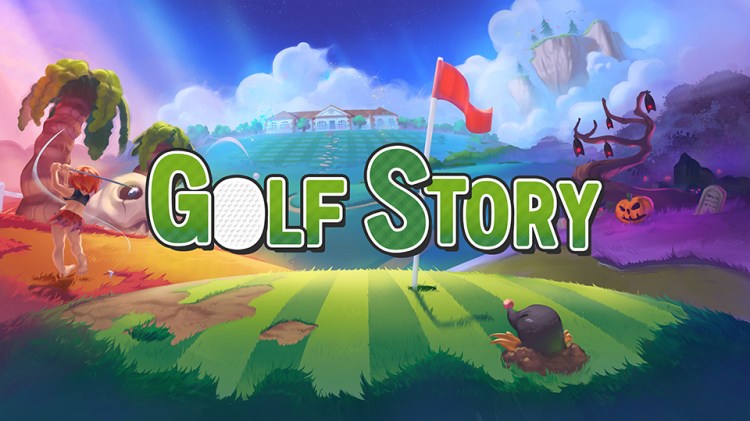
Why is this important, I hear you ask? Alright, that’s a fair question. Ultimately those days of watching Golden Tee were the last of which I gave any amount of attention to the golf genre for many years. I saw that games came out for systems I didn’t have and even if I did they still wouldn’t have rated high on my priority list. Goldeneye was never going to lose out to Waialae Country Club and for good reason. Fast forward to the launch lineup for the Switch and amidst all of the fervor for the system itself, the exclusives, the speculation there was a trailer for a game that immediately caught my attention –
Golf Story.jpg

With that image at the start of their trailer SideBarGames had managed to get my brain reaching for every hype bell it could get it’s grey matter on. The trailer itself was a beautiful blend of heartwarming music, nostalgic 16-bit RPG gameplay and a subject matter you would never consider could fit in so naturally. It wasn’t an outright parody nor did it seem to eschew realism in its entirety for the RPG side, it was… Golf! Most importantly it looked like fun which is something that all these years later as a responsible adult is an aspect that I value very highly in the games I invest my free time. When it released and I finally had time to sit down with the finished product I don’t think it could have more accurately encapsulated exactly what I had wanted, nay, needed from a Golf RPG. Like any outing to the greens SideBarGames didn’t shoot an ace on every hole but for my money, and I suspect many others, it came damn close. So let’s get down to the specifics and story is up first!

Dusting Off the Clubs

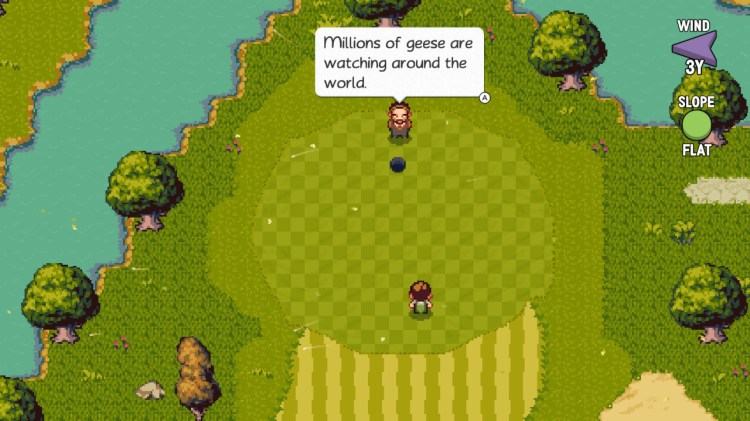
This Golf Story begins on a quaint but idyllic looking course called Wellworn Grove. You are treated to panning shots of the bustling fairways, frustrated golfers in the rough and well hit drives over beautiful water. You are there in line with your father to purchase a round for the day and you begin the game with a run through of some basic mechanics. They’re introduced through a series of father-son interactions on the fairway as he questions how you’ll handle certain situations.
Golf Story Geese.jpg

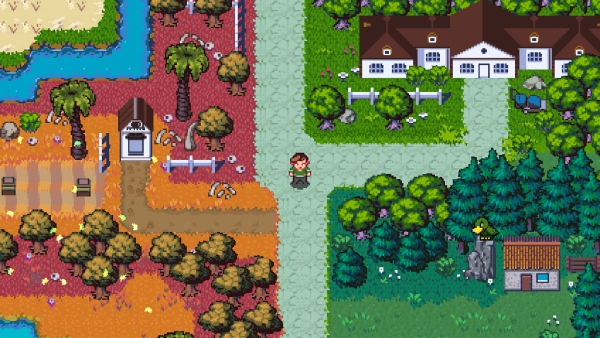
After your successful trial-by-goose you wake twenty years later as a phone rings you out of bed and you are treated to a current day look at that once optimistic kid sinking putts at Wellworn Grove. It seems like life has taken some twists and turns since that fateful day which has landed the player a bit down on his luck. After an angry phone call from the protagonists ex he proclaims that it’s time to fulfill what he set out to do that day on the fairway with his father and join the pro-tour. From here the player heads out onto a world map to see a variety of interesting areas that they can look forward to visiting for now though their first stop is their old stomping grounds. It’s changed a bit in twenty years, the lustre and wonder is gone but the promise of a new chapter in the life of the player urges you on. Like with any RPG you are met by a myriad of characters who have suddenly with your arrival become utterly incapable of handling their own everyday problems. So you will set to work exploring and finding quest givers who provide tasks ranging from proving that some shots are indeed not impossible to identifying mystery switches. Most important among these odd-jobs is still finding a trainer to take a look at your swing so you can up your game for the pros. Naturally not everything will be solvable from the get-go but the various challenges will provide you with money, experience and ways to progress on your journey to the top!

Your travels will take you to a wide range of locales spanning deserts, beaches, mountains and snow covered courses each with unique challenges and hazards. Each course contains a cast of characters, quests and a pro-shop where you can expand your collection of clubs suited to the various environments and your own particular play style. Each of the courses you play on, in addition to providing new challenges, will be home to a tournament you will eventually participate in on the tour. Naturally the first of these will be the Wellworn Grove Open, the kickoff to the players career as a pro. It tests all the skills the player has accumulated to this point against the cast of characters and friends you’ve also gathered. From here on out your destiny is at your fingertips, just remember to fill in your divots and avoid the hazards!

Overall Golf Story tells a tale that is quaint, fantastical and relatable all rolled into one. It may not rise to the level of the gaming industries storytelling giants but I don’t think that anyone will walk away with anything short of a fond smile of their experience.

Overall Story: Lightweight and unobtrusive but well done for those who enjoy narrative elements more so than the combat of RPGs. Plenty of golf centric elements for those who are less interested in the narrative. An excellent blend for all involved!

Pixelated Perfection

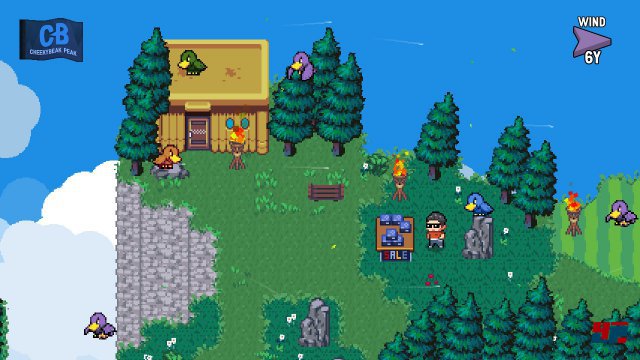
With the resurgence of 8 and 16-bit style Hi-Bit games Golf Story is absolutely no exception. It easily stands shoulder to shoulder with it’s more fantastical counterparts like Shovel Knight, Owlboy, Dead Cells and so many others it’s hard to remember even a fraction of them. Golf Story is certainly far more contemporary than the other games I listed but I don’t feel that fact detracts at all from the games overall appeal or beauty. Honestly there isn’t a lot to say in this section of the review, if you grew up with 16-bit RPGs you’ll feel right at home especially given the fact that you’ll be playing this on a Nintendo console again. If you didn’t but are willing to give the retro-vibe a try I don’t think you’ll be disappointed in the least, especially if you’re a golf fan who doesn’t mind a bit of humorous well written narrative or vice versa.

There are no surprises here when it comes to the graphics, what you see in the trailers and pictures is what you get and for my money it’s worth the price of admission.

Overall Graphics: I think this section is short but if you really need it, fine. Perfectly executed Hi-Bit style that is diverse and beautiful to look at, visually this game is a hole in one.
GolfStoryWorldMap.jpg

GolfStoryMountain.jpgGolfStoryWinter.png

Bump and Run: The Mechanics of Golf Story

Like the graphics portion above there isn’t a whole lot to say in this section as the overall design execution of the game is tight and exceedingly clean. The physics of the golf, in my admittedly limited real life experience, behave as they should. At no point while playing it did I find myself wishing they had a feature which was overlooked or simply left out for one reason or another. You are given a breadth of control over how you approach your game, up to and including a few more fantastical items that let you take your game to the next level. After all what’s an RPG without some special gear you can equip?
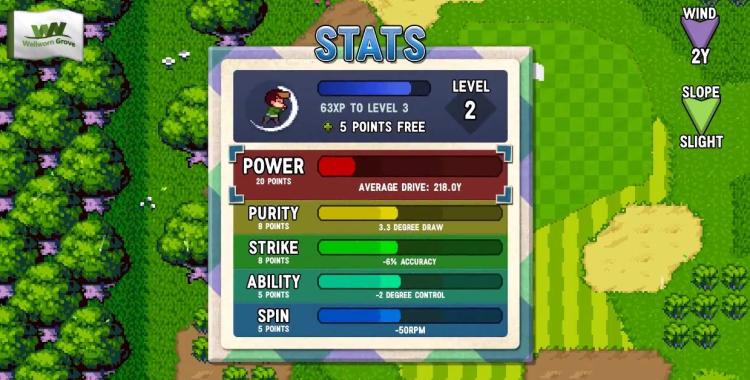
GolfStoryLevel.jpgThe leveling incorporates a stat system that allows you to customize your growth as a golfer but ensures that you don’t cross a (comparatively) realistic barrier into being an unbeatable god on the green. That way the game remains challenging and fun even deep into it’s later stages.

I’ve broken down the stats (As shown above) a bit as they are not always easily understood from the start;

Power – Fairly self explanatory but this is how hard you hit the ball off the tee. If you like monster 300yrd drives then this is definitely for you. However it’s not quite as simple as that because the game will incrementally lower your other stats as you boost your power. It’s hard get that delicate curve, necessary backspin or arrow straight drive when you’re approaching your shot like Happy Gilmore.

Purity – How straight and true each shot you take will be as compared to your intended target. As well as countering accidental spin on shots that may make your ball stop short or roll father than you want. There are many ways to customize your shot but with a low purity stat you may find that your best intentions still land you in the rough.

Strike – While trying to time your button presses on the hit gauge Strike will make sure that even if you miss that crucial press that it doesn’t matter as much. There is even a set of clubs in the game that also work to correct these mistakes.

Ability – This helps increase the effect of spin you apply to the ball as you hit it, either left to right or to borrow a billiards phrase, when you put a little english on it. In addition this effects top/bottom hits that will help a ball stop where it lands or roll far beyond that point.

Spin – This increases the RPM of your chosen spin, enhancing the effect of it on the ball’s trajectory in the air and how it bounces or rolls once it hits the ground.

Like I said before, I am far from an expert on golf in either the digital or physical spaces but the game seems very thorough to me when it comes to handling the nuances of it’s real life counterpart. There are also all of the other basic considerations as you play like various hazards like wind, water, sand, slope, ghosts and what have you.

In keeping with the RPG motif there is also an appropriate but also limited gearing system that further allows you to customize based on your preferred playstyle, environmental conditions and some unique items that give you some additional powers you can bring to bear on the green.

Overall Mechanics: The designers of Golf Story were exceedingly thorough in their detail oriented design which should make even the most die hard golf fans happy. For the rest of us I also think they struck a good balance so that the system isn’t so onerous as to exclude gamers who aren’t in it exclusively for the chip shots, drives and long putts.

Conclusion!

For a digital download cost of $14.99USD and being available exclusively on the Nintendo Switch, Golf Story is absolutely worth the price of admission. An RPG Golf game that sacrifices little if anything from either of its disparate genres to deliver you a complete and engaging experience from your opening drive to your winning putt. What are you waiting for? Get out there and start swinging!
  • Non-Washable


Free At Last!

Free of what you ask? Mobile gaming of course.


The implications given the title I used probably make it sound like I’m going to spend all of these  words doing nothing more than unnecessarily demonizing an innocent and by all measures prosperous industry. Probably true, at least for a lot of it. That isn’t to say that the whole of mobile gaming is rotten but there is a high percentage of casino-like predatory practices which are almost wholly divorced from the noble goal of putting out a quality product. It is not impossible to find classic gaming options on mobile devices where you pay a flat fee for an enclosed experience but a large number of otherwise promising games are locked behind monetization schemes that are little better than having a gun shoved in your ribs in exchange for entertainment. Obviously that example will have people shouting, “But NonWashable! No one is forcing you to play!” and they would be absolutely correct. The flaw I see there is that people want to play these games because they look, and sometimes are, really fun. Much like I did with the couple games which ate up the last couple years of my life I got in thinking, “I know I can pay but I’m just going to go the f2p (Free to play) route and grind out the good stuff. Ostensibly these games are designed so that you can play for free or pay to advance “faster”. The reason I put quotes around “faster” is that what it should really say is “at all”. The advancement is so torturously slow for people playing for free that it becomes clear the only way to truly play the game and participate at a moderate level is to open your wallet. For many people before they know it a line appears in their budget that is specifically for their chosen mobile game. After all, whats $20 a week, really?

The option to pay as many will tell you is for people who just don’t have time to dedicate to advancing without it, a way for on-the-go professionals to have their fun for a swipe of the credit card. It seems entirely reasonable when it’s presented to you and it’s obviously been successful enough as there is a litany of well known lingo within the mobile gaming industry to describe such people.

  • Whales – These are the real catches, the ones who fund the entire f2p mobile gaming industry. They account for nearly %70 of in-app purchases at a rate of nearly ~$350 per month. Whales who have spent in the thousands are not as uncommon as you would imagine.
  • Dolphins – These cap out somewhere around ~$20 per month although it varies up to triple digits in my experience for people who would classify themselves as this.
  • Minnows – Barely a blip on the radar really but cash is cash in these schemes. Often I find these types of players are ones that take advantage of the occasional anniversary deals to get the most bang for their buck.  

There are probably more detailed breakdowns out there available on the internet if you are curious but I’ll let you find those, the above is just to give you a general idea of where the money flows from. While the argument is not wholly without merit that the boosts offered by real cash investments are for people with more money than time, the ugly truth is that the business model of convenience is used as cover to make the games nearly unplayable for low playing or free players. Energy meters are also a popular way of regulating the amount of time you can play in a sitting and forcing players to use valuable in-game currency to continue and then money for more currency. You’ll hear it said that this is an intentional move by developers in order to make it so people don’t binge and burn themselves out on the game, artificially limiting their play time to short bursts. Perfect for where a mobile game should fit into your day. Seems like a legitimately altruistic move on the part of the development team up until a plethora of time limited events and exclusive rewards force you to dip into your game currency or wallet to acquire them. This isn’t even getting into what is required to be moderately competitive for the game’s best rewards, spending money is an absolute requirement. Effectively nickel and diming you for your entertainment, although in the cases of these games it’s usually $2, $5 and $10 dollaring you, up to purchases of $100 at a time. Naturally the more you purchase the bigger “bonus” you get for these virtual currencies. Why spend 5 when I can spend 10 and get a better deal? Then again why spend 10 when 20 is even better deal?   

The most galling part of this for me as someone who loves games is that quite often they are well designed and outside of the predatory practices of the industry in which they are published they would probably be commercially successful. Even the games industry proper is having trouble shrugging off the overtly profitable fleecing practices of nickel and diming its customers but we at least have a history of precedence for fighting against it. The mobile gaming industry fell to this sort of business model so early and so quickly that their customers really have not known any other way. What is worse is that many of the studios who develop these games have bought into the accepted business model so much so that planned obsolescence is factored in from the get-go. They extract as much profit as they can from whatever community jumps into the game when it releases and then let it die or kill it intentionally at the end of it’s “life cycle”. What’s worse still is when the developers for these games are clearly passionate about the content and work tirelessly with the community in order to continually make the experience better only to have it overshadowed by the business decisions.

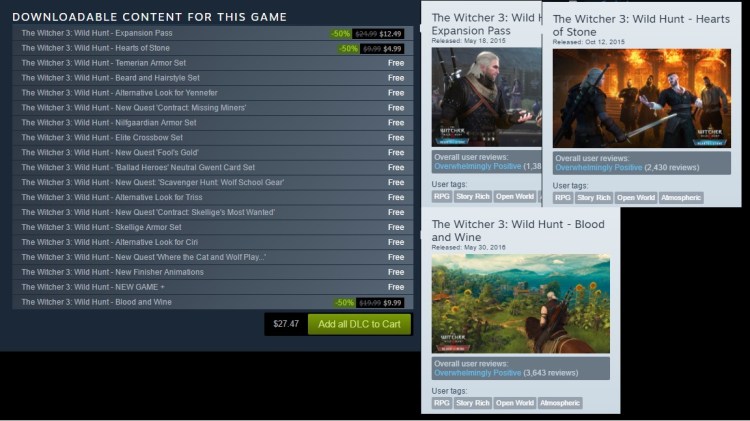
All of this is not to say that the economics of these games is not important as the revenue they generate is how they continue to function. We’ve seen over the years how the non-mobile gaming industry has had to expand its business to generate cash flow beyond the release of games. While these schemes have been met with varying amounts of success or failure there is a constant battle being fought between customers who demand a certain level of quality and studios who want to maximize the profitability of everything they create. There are certainly a plethora of examples to choose from but two that come easily to mind are Fallout 4 and Witcher 3. Taking a quick stroll through the games respective Steam pages paints a pretty vivid picture of what good management of an IP can do.

Fallout 4 while an overall decent game has had much of it’s DLC roundly denounced by its community for being overpriced and delivering too little, while also failing to address problems that were present in the original release.

Fallout4Reviews

Witcher 3 on the other hand as seen below delivered, in addition to a quantity of free updates, DLC of such a high quality that the community couldn’t wait to spend their money on it.

Witcher3Reviews

Ultimately whether you are dealing with mobile or traditional games there is no shortage of people who are looking for any reason to pay for them, sometimes before the quality of it is even known. A business model that is built upon anything but giving customers a product that is worthy of their money is nothing short of insanity. Traditional gaming has been fighting against the slide towards ubiquitous microtransactions and I expect that to continue while modern mobile gaming started there. I think it’s possible for that industry as a whole to pull back from it’s slot machine style schemes and in some limited ways we have seen it although its been largely from major studios re-releasing old games on todays more powerful devices. I can only hope that more of the larger mobile development studios see the value in focusing more on an experience people want to pay for as opposed to games which sucker people into feeling they should pay lest all of their time and investment up till now be wasted via the Sunk Cost Fallacy.

Mobile gaming is certainly not all doom and gloom but after spending a significant amount of my free time over the past couple of years invested in them I do not feel like my time with them was worth the cost, especially financially. The communities themselves were fantastic and keeping in contact with the folks I met has certainly been a joy but it is still overshadowed by the general feeling that we all regret what we invested in the game but not eachother. Not matter how we look at the experiences we had the positive feelings are generally in spite of the game that brought us there and not because of it. Given how much work goes into making and maintaining these games that is a failure in the worst possible way.

Hopefully you’ve enjoyed the read and I hope I’ve made some interesting points! Someday I might delve a little deeper into the games I played specifically or some other aspects of mobile vs traditional gaming but for now I think this sums up my feelings on it.

Have a great day!

  • NonWashable