Nintendo: Why Switch Now?

Watch this. You don’t even really have to watch the entire video but at least the first minute or so. Besides, “Cool!” what is the other first thought you had? I know what mine was, “Ugh, more gimmicks.”

Along with revolutionary and innovative a lot of Nintendo’s attempts to expand how we play games have also been called, in some cases rightly, gimmicky. I think it’s short-sighted to automatically view them as failures though, they may not be commercially successful but I don’t think we can argue against the validity of the attempt. Thinking back the only true innovation flop I could pin to Nintendo was the Virtua Boy. The whole turning your vision red after playing it for extended periods aside the only true problem with the system was that it arrived too early when the industry and its technology weren’t quite ready for it. As lame as you may have felt the motion controls were on the Wii they’re clearly not going away and in fact the current generation VR systems use more advanced versions of them as their main control scheme. Nintendo are also the undisputed rulers of portable gaming in spite of Sony’s best attempts to horn in on the market with the Vita. More impressively they’ve maintained a solid market presence in the face of the ever growing popularity of mobile and tablet gaming.  

Over the years Nintendo has certainly not made things easy on themselves as they have often made business and design decisions that were unpopular with their competition, distributors and game makers worldwide. Their pride in their own history of success has seen them eschew industry standards in order to follow their own path. They don’t release consoles alongside their major competitors or adhere to a similar cycle. They hold conferences and announce their game lineups at their own pace and on their own time. Moves that many have derided as arrogant and indicative of a Nintendo who still thinks that the game industry still operates in its shadow. To even casual observers this has clearly not been the case since even the Wii which most people recall as one of the greatest successes ever for the gaming giant.

Was it though?   

Like most things in life the answer is complicated. It certainly topped sales charts for much of it’s life and reportedly reached a far wider audience than their competition. Fueled by a price that instantly undercut the Xbox 360 by $50-100 and the Playstation 3 by a painful $250-350 at launch. To me the statistic that is most indicative of the complication surrounding the Wii’s supposed dominance is the fact that Wii Sports is considered one of the best selling games of all time. Sounds weird, doesn’t it? Wii Sports was fine, it was fun and something you could play with the whole family but among the best selling games of all time? This record is because the game itself was bundled with every Wii system that was sold. A similar tactic that was once used against them when Sonic the Hedgehog was bundled with the American Sega Genesis consoles. Not only was the Wii cheaper than the other consoles, carried the Nintendo branding but it also came included with a game so you could play the system right out of the box. This was especially potent around the holiday season when the whole family could open presents and then spend hours playing around with this weird new device. Wii Sports stands now with around 83 million copies sold worldwide which is an utterly staggering figure. For the Wii system itself unfortunately Nintendo doesn’t disclose its production costs or profit margins but I feel confident in saying that while I’m sure they made a profit they also cut into it in order to make the impact they did with its release. Their unique control scheme for the system, inviting message of making gaming for everyone and extremely affordable price tag with the added value of a bundled game meant they were instantly part of the conversation again. Let us also not forget Nintendo affection for manually limiting availability to drive up hype and demand by making them seem hard to find as a result of popularity. These combined factors to me mean that an argument could be made for how its success, in part, was in a sense artificially manufactured. I’m sure that statement will be seen as controversial or flagrantly wrong and even I will admit you could call it hyperbolic without being off-base. The reality is that Nintendo made every concession they conceivably could in order to make their system the easiest purchase while not necessarily being the best. The one thing we can all agree on is what a masterclass in business savvy the Wii was, it may not have had the same quippy mic-drop quality as this did all those years ago but all the same, it worked.

Prior to this current console cycle let’s have a quick look at where everyone stood:

Playstation 2 – >155 Million units sold

Xbox – 24.1 Million units sold.

Gamecube – 21.74 Million units sold.

Fast forward to the next cycle and here is what the landscape looked like:

Wii – 101.63 Million units sold.

Playstation 3 – 83.8 Million units sold.

Xbox 360 – 84 Million units sold.

Not a bad turn around for Nintendo, wouldn’t you say? In spite of the system not outdoing it’s competition on any technical aspect Nintendo managed to utterly dominate the conversation which forced Microsoft and Sony to scramble to put out their own motion control systems out with games that supported it. Nintendo proved that the game industry had room for more than platforms bloated with application integration like social media and graphics that edged ever closer to photorealism. It makes sense that there would be but for a company that was on the verge of struggling to be relevant it was a bit of a leap of faith to take and seeing where they are today I am more grateful than ever that Nintendo didn’t abandon their identity to follow along with the market.

I’m not going to delve into the Wii-U as there are numerous post-mortems on the system itself and it’s a well known misstep for Nintendo as a whole after the successes of the Wii. Ultimately based on their aspirations for the Switch I think Nintendo viewed it as a middle ground to carry them until it was ready. With the result we see today from that gamble I think we can safely say it panned out but it also meant that possibly everything was riding on the success of the Switch and that is a risky position for even Nintendo. The other aspect I’m not going to touch on further is Nintendo’s well known affection for artificial scarcity as a way of building media buzz for it’s products. Annoying as it may be it’s an effective sales tactic and one they’ll probably not stop employing for the foreseeable future. Perhaps a topic for another post.
Throughout all of this Nintendo has had incredible success outside of it’s home console ventures with their line of portable systems DS/3DS to the tune of combined worldwide sales in the ~235 million range. Part of the reason I see for that level of success is that Nintendo is uniquely placed among all game and hardware publishers to leverage all of their best first party content on literally any system format they choose to. While Microsoft, Sony and PC game makers have continued to push towards mind-bogglingly realistic graphics Nintendo has staunchly kept to their timeless stylized aesthetic. That isn’t to say that the style itself hasn’t evolved over the years, it definitely has, but the strain that it places on a given system is only a fraction of what it takes to run something like Horizon Zero Dawn, Assassins Creed: Origins and at one point, Crysis. The stigma that this would eventually spell disaster for companies who didn’t keep up is something Nintendo has valiantly fought against for years.

I think the Switch is the perfect expression of what Nintendo has been evolving into since it first introduced the Game Boy alongside its home consoles.

nintendo-switch-banner-790x399-1

When I watched the announcement video for Switch I was instantly filled with a childlike wonder at the possibilities and a very adult sense of dread at what looked like a collection of maybe poorly executed gimmicks. You know the expression, “Throw things at a wall until something sticks.”? That’s what this looked like to me. It was doing too much and as a result would do nothing well. The game quality in portable mode would never look as good as it did in that trailer. If it did then the battery life would be worse than the notoriously bad Game Gear or Sega Nomad. Even if all that could be worked out it wouldn’t be powerful enough to make those games look good on your living room TV and god only knows what kind of performance issues you’d see with games that were even remotely recent. Tiny detachable controllers that look awkward to use, motion controls (again), cheesy party games and yet again promises of third party support that Nintendo had been repeating for years. Almost every pitfall they’d been trying to stay out of for at least two console cycles if not more all wrapped into one single platform.

Could it really be anything other than a disaster?

I am proud to say that through my dread I was actually hopeful about it’s chances and I argued fervently with naysayers who couldn’t see the potential. I’ll fully admit that my excitement came in no small part because after not owning a Nintendo system since a Gamecube, that was purchased late in its life, I was so amped up to see even a small spark of life from Nintendo. After some thought about the reveal video and the company itself I settled on feeling optimistic because it seemed to me that the Switch was Nintendo finally embracing its place in the gaming industry. It had relinquished the battle on cutting edge visuals and withdrawn from the rest of the console industries attempts to claw closer to rivaling PC hardware. They had already cornered the market on portable gaming and had a first party lineup that no other company in the industry could possibly compete with combined with the mission statement they announced with the Wii.

Introducing … Wii. As in “we.” While the code-name “Revolution” expressed our direction, Wii represents the answer. Wii will break down that wall that separates video game players from everybody else. Wii will put people more in touch with their games …”

Accessibility, portability, timeless aesthetics and some of the most legendary IPs in video game history meant that their real challenge was figuring out a platform that could truly speak to their strengths. Like their previous offerings the Switch won’t put your 4k TV to the test or run Crysis but true to their tradition that has not stopped Nintendo from delivering some absolutely stunning visuals any video game fan can appreciate.


Legend of Zelda: Breath of the Wild

BoTWSShot More gifs here courtesy of @mangosango on imgur.

Super Mario Odyssey
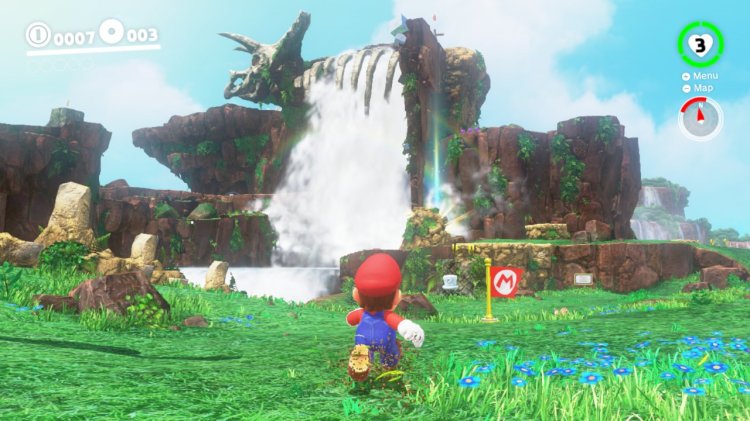
smo_07

Xenoblade Chronicles 2

Xenoblade

This isn’t even scratching the surface of the total games on offer including a very impressive set of indie titles. This also doesn’t include The Elder Scrolls V: Skyrim, DOOM 2016, Bayonetta 1&2 which have also released on the Switch. The software support for the Switch has been more than adequate and the future is also looking bright with a new Metroid title, Super Smash Bros, Dark Souls Remastered, Kirby Star Allies, Lost Sphear, Mario Tennis (Don’t laugh, it looks awesome.),Mega Man 11 and one of my personal most anticipated, Octopath Traveler.

The software support is real so what about the hardware gimmicks? Of all the things that excited me about the Switch I do have to confess that the ability to use it as a portable was not at the top of my list realistically. If I’m going places then chances are I’m going to be doing things that require my full attention so playing a game outside of something quick on my phone isn’t in the cards. The first few weeks of playing Breath of the Wild the system never left its dock as I was perfectly content to sit on my couch to enjoy it. One night I wasn’t quite to a point where I was ready to quit but my girlfriend had gotten up to go read in bed before falling asleep because she had to be up in the morning. Cheesy as it sounds we’re both busy adults and there are some weeks where we really don’t spend much time together and sometimes it’s nice to just be near one another even if you aren’t really interacting. I didn’t really want to sit and play alone so I saved my game and was about to turn off the system when I thought, “Just a sec, I can just take this thing with me!”. I had yet to see what BoTW looked like with the system in portable mode so now seemed like the perfect time to find out the truth. I undid the JoyCons from the controller frame and slid them onto the tablet, somewhere deep down expecting to be disappointed in what happened next. However like I was standing in for one of the people from the announcement video I slid the screen out of the dock and snappy as could be my TV went black and my game appeared immediately on the handheld. So far so good. I walked to the bedroom and settled in next to my girlfriend who was reading her book, she stopped for a moment when she saw I had the Switch and checked to see what it looked like. We were both pretty blown away by what we saw, it was the exact same game. It didn’t look squished or blurry, in fact it was perfectly crisp and played as smooth as you could want. I spent the next hour finishing a couple of shrines and two Korok puzzles we had stumbled across and could have easily played until the battery died on me. I turned the system off, reluctantly put it on my nightstand and went to sleep still buzzing a little from the excitement that it had worked exactly as advertised.

Since then I’ve had to actively remind myself that I can play it wherever, someone wants to watch something on the TV? Cool, let me just undock my game quick and we’ll chill on the couch together doing our separate activities, together. It’s gotten to the point where I find excuses to use it portably whether I need to or not. It’s just such a pleasure to use that you want to take advantage of the systems features. It’s like when I realized many years ago now that I could stop watching Netflix on my TV, get up and resume where I left off on my phone app while I worked on chores around the house. Every extra “gimmick” on the Switch is just… useful, it feels and operates in a way that is fun and unobtrusive, you just want to see what it can do. Even the motion controls I think have been handled perfectly as they are largely optional for any game they are included in. I was initially worried when I learned that Super Mario Odyssey included some motion controls but after playing it they were just a fun addition that I think enhanced the experience instead of detracted from it.

I want to take a moment here and mention that not everything with the Switch is perfect, there was a controversy at release over the very limited system memory which could clash rather significantly with the size of modern titles and the prevalence of non-physical releases. It was basically recommended from the get-go that you purchase extra SD memory to fix the problem regardless of if you thought it would be a problem for you. There were also some quality issues with the screen and build of the systems at launch but Nintendo did an incredible job with warranty replacements and making sure customers were taken care of. Since the initial problems it seems Nintendo got them ironed out and I’ve heard little or nothing since. Overall though besides some supply shortages those were the worst problems the system has faced thus far.

I think for me this is where Nintendo is destined to exist but not because of any failure on their part or because they just can’t hack it against Sony or Microsoft. From the dock to it’s JoyCons the Switch is the distilled vision of everything that has made Nintendo a household name in the video game industry for the past forty years. The Switch reminds us that framerate, pixel count or 4k capability is not the ultimate endpoint of game design. Time and again we are shown that all the money, resources and, hype won’t make a bad game good or a good game great. Eventually the truth of it will be known even if its slightly obscured at the start. There are still a lot of unknowns about the Switch and its future given that even now its barely more than a year old as a fully released console. In that time though the impact it has had is undeniable and its place in the conversation is not up for debate.  

To date the Switch is selling exactly as fast as the runaway success that is the Playstation 4.

Welcome back, Nintendo.

  • Non-Washable

Things I Desperately Need to Do

How often do you look around at your life and realize how many little things you desperately, urgently need to do? Followed by the instant realization that there are not enough hours in the week to get them all done. Hopefully you don’t do this too often because it can be a somewhat hellish vortex of despair. Once in a while though it can help you to put together a bullet-point list so you can prioritize those needs into something resembling sanity.

In the spirit of transparency here is what my current list looks like:

  • Make and eat lunch
  • Stay on top of the ongoing Magic: The Gathering Arena beta
  • Keep up on my RSS feed for news
  • Finish editing two videos I’m working on
  • Officially start on my SW: Legion content – Unboxing/Assembling/Priming/Painting 1 or more models by the end of this week.
  • Write-up on Ni No Kuni and my first handful of hours with it.
  • Back to Vermintide 2 for at least an hour or two this week.
  • Podcast tomorrow with Soapy – Need to write my outline
  • Editing and finalizing the last two podcasts we’ve done so they’re ready to upload
    • Improving my editing and looking for ways to improve the cast
    • Music of some kind for the intro? I dunno, something I’m thinking about.
  • Finalizing my notes for this Saturday’s D&D game
  • Choosing a topic for the next blog post (Not including this one) options i’m considering:
    • Epic open sourcing $12mil in Paragon game assets after its closure.
    • Some thoughts on the Might and Magic mobile game
    • A “Why” for the Nintendo Switch for a friend who didn’t buy one and is curious. Plus I really like the system.
    • Video Game Movies
    • Probably other things too
  • Making additional tweaks to the camera I’m using because blurry is not what you want while working with minis.
  • Working on taking more editing time with my posts. I really need to do this. For now I’m just happy to get things done and up but the quality could really be better. Better to establish good habits now than try to do it later.
  • Stream a little more often when I make time for games. I may as well since it’s not really intrusive to what I’m already doing and it seems fun? We’ll see.

And of course there is more that isn’t even related to what is going on with this blog because life is life. The one thing that I will say about my head first dive into all of this starting a couple weeks ago is that it feels so markedly different than anything else I’ve ever attempted and eventually abandoned. I don’t mind doing it. All of the other things I’ve had to learn while doing this don’t feel like a burden, it’s fun and educational but it keeps me at 100% capacity all day with few breaks. I don’t know if that is good or bad right now but I didn’t burn out after the first day or get bored with any aspect of it and that isn’t really something I’m familiar with.

So… good? We’ll see but for now I’m enjoying it and it feels good to be productive on things I actually care about. I don’t know where it’s going or how it will end up but I’m going to try and find out for once instead of tossing it. I’ve already cleared quite a few speed-bumps which is another thing that usually derails my ambition.

At any rate, no more rambling. Stuff to do! I’ll be back around here on Saturday or Sunday evening with one of the articles I mentioned up top. I’m hoping as I continue to do this a few days a week that it’ll help me tighten my game up and get faster as I do it.

Now, for some fun! Someone on Twitter was asking about the molds on the SW: Legion figures so I took a few close up pics so he could get an idea. I honestly think they look great and the details look like a lot of fun to paint! Feel free to have a look.

Thanks for hanging with me, happy gaming!

  • Non-Washable

Lootboxes: A Random Chance at Fun

In an ever increasing suite of tools that developers and publishers use to monetize their games why is it that lootboxes stand out head and shoulders among them as the most odious? Lets look at a quick and dirty list of monetization schemes currently present in the game industry before we get started, in no particular order:

  • DLC
  • Season Passes
  • Lootboxes
  • Microtransactions
  • Premium Currencies
  • Pre-Order Bonuses
  • Platform Specific Content
  • Publisher Specific Content
  • Retailer Specific Content (Gamestop)
  • Early Access
  • Alpha/Beta “Testing” with Purchase
  • Forced Multiplayer/MMO Lite Mechanics
  • F2P Games (Cost More in Aggregate Than a Full Price $60 Game for the Experience)
  • Full Price $60 Games That Still Include Microtransactions

I’m sure there are more but that list is just what comes up off the top of my head. A lot of these you might say could be combined into a single category or are now defunct practices which is a fair criticism. A lot of these things are tied very closely to one another in their implementation but I’ve broken them out like that because it makes it easier to visualize all the different avenues used to siphon more of your entertainment dollars. A practice that I actually have no problem with in theory as long as what you are getting in return is commensurate with the price tag placed on it which is largely not the case in most of the above examples. Today though I’d like to specifically address Lootboxes and why even the “fairest” implementations of them still sour what may be an overall excellent game experience. Lootboxes are a sort of gambling mechanic introduced into games to serve as an alternate form of progression that sidesteps the investment of time and skill for real world dollars. The argument for why this sort of system is okay is predicated on the idea that it is primarily for players who have more money than time. It’s not an argument without merit however it requires such a delicate balance in order to maintain fairness for people who don’t want to pay vs those who overwhelmingly pay to advance. This results in a system referred to as “Pay to Win” when a game has a multiplayer component whose real money transactions confer a competitive advantage on those who use them. It undercuts the importance of skill and emphasizes instead the size of your entertainment budget and the overall luck of what randomized items you get from Lootboxes. Few people want to play a game where on release day players who purchase $1,000 in microtransactions can artificially reign supreme while players who grind their way will have a much harder time doing so. There have also been rumors and rumblings around the industry that companies have gone so far as to use multiplayer matchmaking as a sort of advertisement for items gained through microtransactions. The algorithms used to keep matchmaking roughly even based on skill instead will match newer players with ones who are significantly better equipped in order to encourage the less equipped players to buy lootboxes to be competitive. YouTube creator SidAlpha had a fascinating and chilling video out back in January about the future of microtransactions in games that I highly encourage you to watch for how these mechanics are viewed from the business side.

As these predatory practices have gotten a foothold in mainstream gaming it’s been a rough road for adoption as gamers have fought each step of the way to keep them from becoming the new normal. Unfortunately while it slowed their implementation it has done little if anything to stop it, companies were simply making too much money from them due to the large majority of industry customers not speaking out or still purchasing titles with microtransactions while “Not planning to use them.”. While the sentiment is nice the purchase of the game itself is still profit for the company and as we know not an effective protest of these policies. Thankfully the rise of Indie titles in the last handful of years has given people other outlets and has made it easier to avoid entirely Triple A titles laden with microtransactions and lootboxes. Nintendo has also, as far as I know, steered clear of microtransactions in their games and only this year will for the first time charge for their consoles online service with the Switch. Throughout the last few years language has begun to creep into game development like “Games as a service” which implies that design was now more focused around ongoing experiences that don’t end after a single playthrough but instead keep players returning indefinitely. Linear single player games are tough to monetize like that so multiplayer became a necessity for any title attempting to do so. Adding co-operative or competitive multiplayer to games is not inherently a bad thing however it can still cause problems. If the game development did not originally include a multiplayer then time and resources must be diverted away from the main focus of the game in order to create it which could end up leaving the whole product worse off at release. Games released in that state can feel markedly worse with the inclusion of microtransactions especially if you already feel like you overpaid with the initial $60 price tag.

Over the years many different styles of microtransactions have been tried with varying degrees of success and there are some important distinctions within that:

DLC Packs – Games like the infamous Train Simulator which boast a whopping 437 pieces of downloadable content for sale at a staggering price of $4,132.24 and thats when its on sale for anywhere from 40-90% off. A more popular example would be Just Cause 3 with 12 additional pieces of DLC adding more than the cost of another full Triple A game at $63.39. The Sniper Elite games are also notorious for the slew of small DLC packs post release. Sniper Elite v3 offers an additional $67.87 worth of post release content. Dead or Alive may be one of the most head-scratching examples of this list with the most recent iteration sporting 71 additional DLCs at the low price of only $1,289.79

Cosmetic Only – Games like Overwatch which are critically acclaimed across the industry offer lootboxes however the contents contain only cosmetic items that have no effect on the gameplay, removing balance issues like we’ll get to below. Counter-Strike has a similar system of cosmetics that live completely outside of the mechanics of the game. Most MMOs who implement these microtransactions make them largely cosmetic however when they don’t they are generally very careful about keeping their balance carefully in line with non-premium items. The new Far Cry 5 also includes these types of microtransactions.

Non-Cosmetic Items/Buffs – In this category is where we find games like Battlefront II whose lootboxes were heavily criticised for being “Pay to Win” as you could boost your power and access to items significantly just by paying. AC: Origins although only a single player game has microtransactions that offer more than just cosmetic items including the ability to buy crafting materials and skill points with real money. Middle-Earth: Shadow of War contains an almost needlessly complicated microtransaction/lootbox system that I’m putting under this heading for several reasons. Here is a story over at Kotaku that has a decent breakdown if you’re curious. While I would not classify Team Fortress 2 as a classic Pay2Win game items you can acquire through microtransactions are not strictly cosmetic so it belongs here.

Of these three main types the DLC and Cosmetic only systems are the least offensive for the majority of gamers because they ostensibly exist outside of the full priced product that you buy which should contain the entire experience. Both of these methods were also not popular at the times they were introduced as people rightly felt that studios were holding back content from their initial releases just so it could be sold later and they were not entirely wrong. Day one DLC was a stumbling block as it has been proven several times that DLC content was already loaded onto discs that were sold on release day. Purchasing the “downloadable” content simply grabbed a key which unlocked the content that already existed on the disc seemingly proving that studios were holding back content that should have released as part of the $60 purchase. This was not the case for every game that had DLC but even one unaddressed instance of this opened the door for it happening more and more often. The furor over day one content seemed to hit a peak with Mass Effect 3 when it released with a piece of DLC that contained what many felt was a vital piece of story content that had been teased in the lore since the series started. To put it lightly the move was seen as underhanded and greedy when the people they were fleecing had been loyal fans for nearly a decade. When you see me talk about the developers and publishers responsibility to treat their customers with respect that is a perfect example of a failure to do so. The incredible loyalty and love that Mass Effect fans had for the series waned heavily in the wake of several missteps made with the third entry all of which were entirely avoidable. The other issue with DLC comes in the form of Season Passes which have a questionable value return since the early days of their implementation. Like DLC in general it has certainly been done well but the number of times it’s been done poorly far outweighs them. Essentially a Season Pass is a way for companies to add another layer of Pre-Order onto just the physical game. Ranging anywhere from $24.99 to $39.99 on average the combined cost prior to a game release can run you up to $100 and the Season Pass content that you pay for is entirely blind. Occasionally companies will offer some vague descriptions about what you will be getting but it’s not enough to make an informed choice in my opinion. Season Passes can usually now be purchased after a games release and will sometimes even be discounted during sales which sort of invalidates the entire point of them. There have even been some bizarre instances on Steam where either the Season Pass or the individual DLCs will be significantly cheaper than their counterparts due to big sales. I’m not sure what causes the oversight but at the end of the day I suppose a sale is a sale, right?

Overall for the things that can and do go wrong with the use of DLC I do think that there are enough companies out there selling worthwhile expansions to their games that this is something we can continue to live with. We have enough resources and reviewers at our fingertips that we should be making informed decisions about post release content that is worth our money and time. I would caution against purchasing Season Passes prior to the release of the base game, the passes will be available after launch so there is no reason to make what is most likely a non-refundable purchase of digital content. There is no rush, if you like the game then it’s nice to know that there is still more to do once you finish the core content. 

This brings us to cosmetic only microtransactions and over the years I’ve gone back and forth over whether or not these are something I feel belongs in gaming. Overall I think I’ve landed on being mostly neutral about them since they are entirely optional to my overall enjoyment of a given game. Overwatch and Counter-Strike I think are two good examples of how to handle cosmetic only microtransactions however they fail in one significant way that makes me largely ignore them. Blizzard’s title Heroes of the Storm has cosmetics on sale for real money but the important thing about their system is that you can purchase the exact item you want with no mystery or disappointment. There are also a selection of skins on offer that can be bought with in game gold which gives players who don’t want to pony up the dough a method to still customize their characters. This, to me, is the absolute ideal for cosmetic microtransactions as it utterly removes the distasteful and predatory gambling aspect of lootboxes. Lootboxes may be more profitable simply due to their unpredictable nature but being able to purchase what you want and only what you want will yield happier customers who are content with the money they have spent in your game. Warframe developer Digital Extremes takes this approach to their totally free to play game and has seen incredible success with it as players can spend their money on items that will specifically enhance their individual experience. Virtually eliminating disappointment and regret, two things you never want to feel with your entertainments monetization scheme. Overwatch and Counter-Strike are a close second however even though the randomization of their lootboxes can yield consistent and expensive disappointment for people who spend their money. Overwatch has the advantage of selling their lootboxes for roughly $1 per box with better bulk deals as you buy more, far and away the cheapest cosmetic boxes I’ve run into. They also completely avoid the irritation of a premium currency you must buy in order to then spend on the boxes. Counter-Strike similarly mitigates the annoyance of random chance by allowing people to sell skins they acquire through the marketplace which gives players the opportunity to avoid the reward chests and just buy what they want. The downside to that system is that since they are collectible and some of them can be quite rare it can make the occasional skin sell for hundreds even thousands of dollars on the market. Overall I would still say their system is better than most at giving people options on where and how to spend their money.

Cosmetics allow a nice balance of choice for people who want nothing to do with competitively necessary microtransactions but still want the customization options or to just support a developer they like. Another plus to cosmetics is that many games allow even free players to earn the occasional lootbox just through regular play when they hit certain milestones meaning that even if you aren’t actively purchasing you still earn rewards. Most likely I’m sure their data has shown that giving out occasional free lootboxes increases engagement by non-money players. The motivation aside it bears mentioning. Given the alternatives I find this to be a perfectly acceptable way for companies to monetize their games while being fair to their customers.

The ugliness of this entire subject falls in our final category of Non-Cosmetic Items/Buffs which happens when developers lock game altering items, buffs or even characters behind a paywall meaning that it causes a rift in the playerbase. Most multiplayer games and their appeal are predicated on tight balancing that means winning or losing is down to individual or overall team skill and co-operation. Any outside factors that tilt the scales one way or another are seen as unsporting, frustrating and ultimately game breaking. It’s one thing to work your way to the top and another to simply buy your way. I already spoke earlier about Pay2Win models so I’ll try to minimize my rehashing here by commenting on something that Battlefront II did to further exacerbate the already huge problem with being Pay2Win. The “free” avenues for progression in the game were made so arduous and time consuming that it would be nearly impossible to earn new heroes, equipment or star cards without dedicating most if not all of your free time to exclusively grinding that one game. Reality is that very few if any gamers limit themselves to playing one and only one game for a year let alone multiple years consecutively. Since I began gaming over twenty five years ago I cannot remember a single time that I was so obsessed with a game that I played it to the exclusion of all others for longer than perhaps a few months at most. EA seemed to be under the impression that players would be happy to make Battlefront II essentially a second job. If that wasn’t the case then they had the option to spend hundreds if not thousands of dollars on lootboxes to unlock content they technically already paid for. Lootboxes may far and away be the most profitable type of monetization but it is also the one that sports the most anti-consumer method of extracting those profits than anything that came before it. If that isn’t bad enough the entire game is geared to push you towards purchasing them as a necessity. It’s no longer an option for convenience so that busy or not any player can make progress but rather some games treat it as the only reasonable means of progression if you are a human being who occasionally has to do something other than play. The subject of these transactions when it comes to single player games allows it to side-step the issue of “fairness” but I can’t help have a sour taste in my mouth after seeing them. It makes me question whether or not the in-game “grind” was made intentionally worse to nudge you towards opening your wallet in order to grease the way. Am I paying to just lower the difficulty of my single player game now? It feels like it sometimes.

The reality is that microtransactions of all kinds are here to stay and there is little we can do to change that. What we can still affect though is the extent to which they affect our experiences. The fervor that met Battlefront II  it seems we as a community have sent a clear message on where we draw the line. I could have lived with us drawing it a little sooner but given EA’s recent decision to completely remove microtransactions from Battlefront II I think we did okay. As always we’ll see what happens going forward, it wouldn’t be the first time they’ve backed off only to reintroduce it in a more insidious fashion down the road. So keep a close eye on it.

Finally I just want to say that as a gamer you should never feel like your time and money aren’t worth some consideration by the developers and publishers we buy our games from. I’ve said it a thousand times but we want to give these companies our money and we are constantly looking for excuses to. They have only to put out a product worthy of that money and they’ll see their profit, we don’t need to have sneaky mechanics trick us into doing it, we’re already willing. It’s tantamount to walking into a store and then having an associate jam a gun in your ribs and take your wallet. Why? I’m already here to spend money, just show me something worth buying.

Don’t be afraid to let a game go un-purchased if it deserves it, there are more than enough titles to keep you occupied in the meantime.

I’m sure I’ll do a follow up at some point on the other things I listed at the start of this but this article is long enough as it is. Until then, happy gaming! I’m off to play some more Ni No Kuni 2 while impatiently waiting for the arrival of my light kit so I can get to painting my Star Wars: Legion minis. And recording that journey for their embarrassing entertainment it will undoubtedly yield.

  • Non-Washable

*I know I didn’t mention GTA:V in this post even though it’s online portion definitely deserves to be here given the microtransactions, I didn’t feel like it would necessarily add anything that the games already represented couldn’t do adequately. If you feel otherwise leave me a comment and tell me why!