Ni No Kuni 2: An All You Can Eat JRPG

Minor Spoiler Warning: Below are screenshots that contain very minor spoilers regarding characters you recruit in the game, locations you will visit and, game systems/menus.

Author Note: The Imgur links below the images are because I have yet to figure out why WordPress doesn’t offer a native zoom function on images in posts. I’d probably be better served using the HTML formatting for these articles but that’ll have to come down the line. For now if you want an up close look at the images click the imgur.com link, it’s a safe image hosting service used by millions, I promise. It also works decently well on mobile. Apologies for the inconvenience, I’ll try to figure out a better way.

I’ve been doing my best to put some time into the newest offering from Level 5 Studios and if I’m honest it’s pretty hard to put down once I’ve started playing. As I said on Twitter the game gets off to a fast start where the first entry had a slightly more meandering beginning where you got a chance to familiarize yourself with the setting. Both approaches definitely have their advantages and the first I think definitely benefited as most people were excited to get an interactive Studio Ghibli world. Level 5 even without Studio Ghibli have maintained a similar level of animation quality and style which is very admirable, unfortunately the story itself is largely uninteresting and wouldn’t be out of place in a childrens Golden Book. Again I can’t really say that this is strictly a negative as most RPGs are built on the same painfully similar scaffolding, at the end of the day what sets them apart are their moving parts and window dressing. In those aspects Revenant Kingdom soars above many of its contemporaries with a fabulously whimsical art style, unapologetically cheesy setting complete with mouse-stache twirling villains. The genuinely fun aesthetics aside what I really wanted to talk about here are the surprisingly robust set of game systems you have to learn in just the first handful of hours.

Lets get started!

Early on you’ll be introduced to the basics like movement and camera control before being thrust directly into combat for the first time. The active combat in the game is fairly easy to get the hang of much like the first you have a restricted area you are allowed to move around in however instead of selecting an action you are free to hack away with your chosen weapon and unleash special moves via quick keys. Overall it’s a much more fluid and frantic battle system with little or no downtime that I’ve experienced thus far. More on that later.

One of the first comparisons I began to draw after a few hours in was to the nearly interminable tutorial that was Final Fantasy 13 which was famous for not taking the training wheels off until around hour 30. Revenant Kingdom hasn’t, at least not yet, even come close to that but six or more hours in I’m still being introduced to new menus and aspects of the game that I need to actively manage as I go. I won’t go so far as to say that any of them so far seem overall bad or poorly thought out but I do question how much they will evolve over the totality of the game without it being completely overwhelming. I’ll be the first to say that complexity isn’t a bad thing but that doesn’t mean burdensome systems won’t drag down an otherwise great experience.


Menus, Menus and More Menus

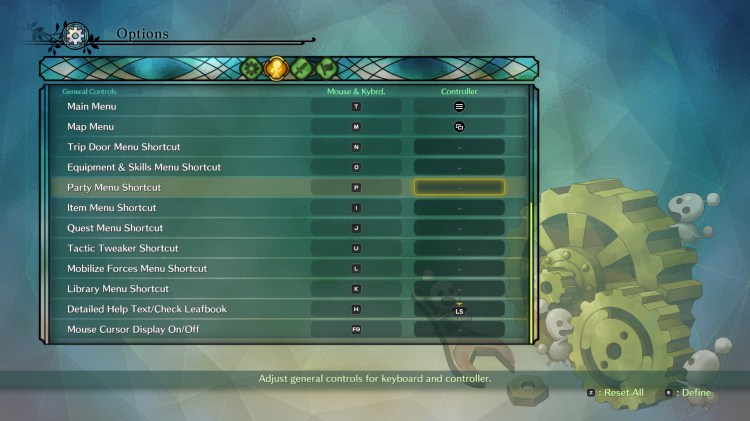
First here is a screenshot of the keybind list, almost this entire page is just keys to access the various menus for the game.  
PCControlshttps://imgur.com/O4tFknt

Am I crazy or does eleven seem like a lot? Looking back for some comparisons to even some of the more complicated RPGs like FF7 that party menu topped out at eight and you really only ever used three or four of them regularly. So what are all of these menus and do you actually use them all that often? Full disclosure there is a general menu you can access that looks like this so the hotkeys aren’t the only option otherwise playing this with a controller would be interesting to say the least.

One of the earliest screens you’re introduced to is the Equipment & Skills page which is where you can change out your characters weapons, armor and special combat skills.

EquipmentSkillshttps://imgur.com/he2VDS3

You’ll be visiting this fairly regularly as new gear is always dropping in combat and with each character able to wield up to three of the weapons they are proficient in at a given time there is a lot of juggling that happens. They can only wield a single ranged weapon which simplifies that a little bit. This is pretty standard equipment juggling that comes with these types of games so if you’re familiar with the genre this will be second nature.

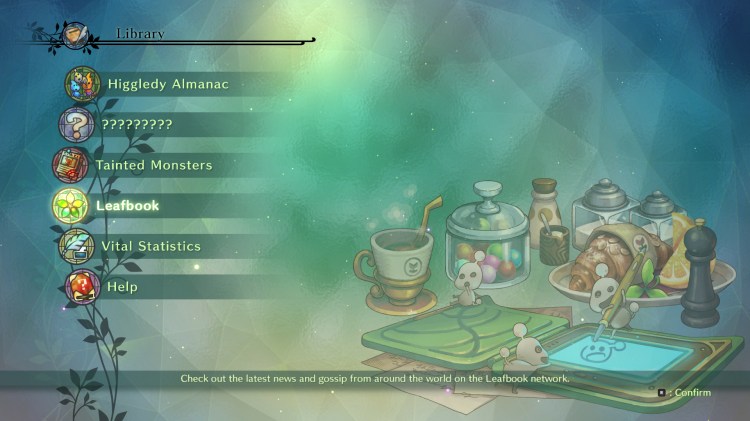
Another early menu will be the Library which is your codex of sorts which will keep track of monsters you’ve encountered, gameplay statistics, help files and a few other things.
Libraryhttps://imgur.com/zut8RMY

I can’t say that so far this particular menu page has been one I’ve visited often or at all really but it’s mentioned several times in the games tutorial as a place to go if you need a refresher on how some system works. If there happens to be a day or two in between my play sessions I can see myself skimming the help files for a few reminders.

Your item page will be mixed in here as a place you’ll need to go to browse through the nine tabs of different types of pickups in the game.

Itemshttps://imgur.com/o652KYj

Inventory management should be no surprise to any fan of RPGs but never before have I given vocal thanks to whatever designer decided to not impose any sort of inventory limit on players. Not that I’ve found yet, anyway. One of the things that surprised me early on is the sheer amount of chaff that you accumulate in your first several hours of the game. They do eventually serve a purpose but there is stuff littered literally everywhere that you feel compelled to pick up. You have no idea why you need this stuff and by the time it becomes relevant you will have pages and pages of unusable items that you’re hauling around. I was approaching hour six of my game when I started to get worried about what the crafting system would look like based on the sheer amount of hoarding I’d done thus far. Items that appear on the ground also reappear almost instantly if you move even a small distance away so if you’re the least bit neurotic about cleaning out an area as you go don’t expect to leave an empty map behind you. The other part about the tidal wave of debris you pick up after each fight is that none of it seems especially important or indigenous to a particular area. After my first six hours I couldn’t honestly tell you where I would go back to in order to find more of a particular item. For context after six hours I have 80 distinct crafting materials in my inventory and not really any idea where any of them came from. I can only imagine that list is going to continue to grow as I keep exploring or at least I hope it does as the world map seems fairly large and picking up just them items for the rest of the game would make all the detail put into this system seem more like pointless fluff. Ultimately I don’t think all of this will effect my enjoyment but I always hate to see hard work like this get wasted as filler.

Next up an old standby with the Quests page, a handy place to keep track of everything you have going on currently as well as what you’ve already completed.

Questshttps://imgur.com/lmco8Zy

For games like this your maps for navigation are important so you know where you haven’t been yet and naturally whatever fast travel options you have open to you.

This area map shows you your immediate location with some fog of war to indicate where you have yet to explore.

AreaMaphttps://imgur.com/jdg2tbp

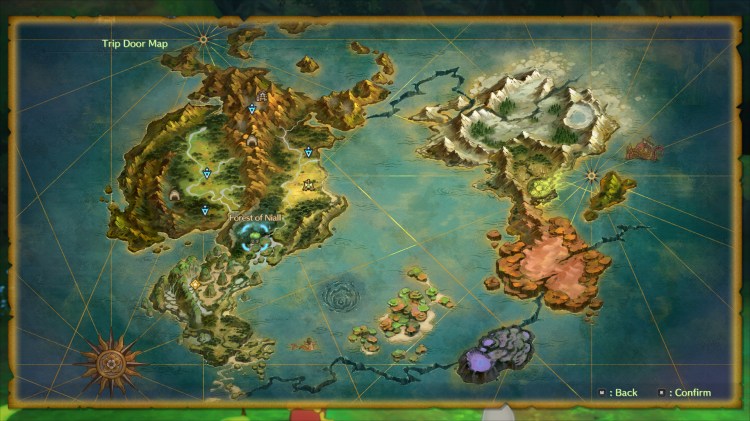
The world map shows you a very nicely designed map of the entire world with markers indicating “Trip Door” locations that serve as your fast travel options. Each pin on the map can be clicked on and you can see a selection of more specific locations in that area that you can travel to if you’ve unlocked them.
WorldMaphttps://imgur.com/u2eqpCF

Unsurprisingly this game also includes a party window which we’re introduced to as soon as you encounter your first Higgledy which are… sort of hard to explain. Imagine this but slightly less creepy, more magically powerful and your allies in combat!

Partyhttps://imgur.com/UVo4rUV

Each Higgledy has different stats, effects and personality which you have to balance against the other Higgledy’s you bring with you. I’ve only accumulated five of them so far so I haven’t had much chance to try out different combinations but at their base level they are cool to use in combat and offer some additional variety.

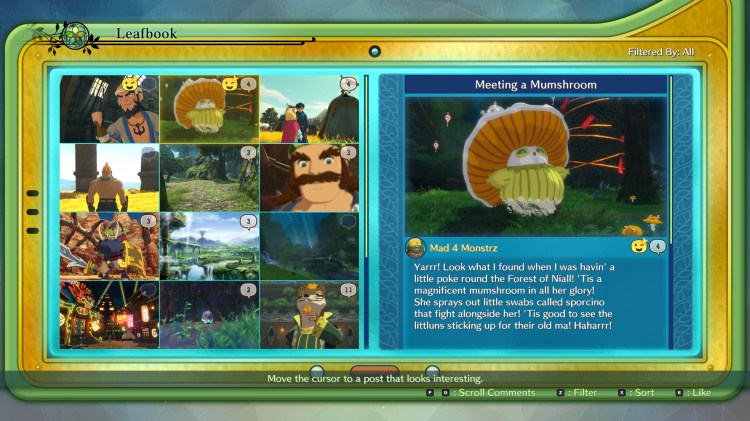
Sometime around here we’re also introduced to Leafbook which on top of everything else you have to keep up on is Revenant Kingdom’s take on a fantasy social media platform. You’ll find pictures added to Leafbook complete with comments from unknown and known people. I’m still not entirely sure what “liking” a picture on Leafbook does but it seems that some of the pictures posted there are hints to treasures and optional quests if you need a diversion from the main story.
LeafBookhttps://imgur.com/AIcQrwJ

The game will regularly let you know about new posts that are available to be looked at on Leafbook, if you didn’t already hate the unwanted messages you get from Facebook in real life just wait until you also get them in-game! It’s not actually that annoying to deal with but I can’t help but feel that maybe there was a slightly more clever way to do this that wasn’t, “Here’s a tablet! Use it to check your fantasy social media! Bye!”. At some point in the design phase for a game you have to make cuts for systems that aren’t important enough to dedicate the time to fully integrate. This probably should have been left in the idea pile for next time.


One of the original nuggets of information we were given about Revenant Kingdom prior to it’s release was that you would spend your time with a robust nation building system which had certainly piqued my curiosity. As a long time RTS fan any game that promises me the ability to play a pseudo-RTS inside of one of my other favorite genres I am on board. You may notice that we have yet to talk about that and it’s because after five hours I still haven’t seen or heard anything about it besides the odd reference in story dialogue. Believe it or not we still have two more game systems to talk about before we even get to that part.


Whats building a kingdom without a little large scale warfare? That’s right we have warfare mini-game reminiscent of a super slimmed down Total War featuring chibi versions of your army. I won’t lie it’s disgustingly adorable and one of the first generals you get is named Chingis which while being a bit on the nose is kind of awesome. Warfare deviates from the normal RPG game-loop and gives you an additional activity to take advantage of on the world map as you travel around. I’m not sure if these battles you fight will play a larger role in expanding your kingdom but I’m definitely curious to see where it goes.

Armyhttps://imgur.com/NRiofFa

This menu is where you go to manage the four companies that you take into a given battle with you, so far I only have two but so far this is one of the things I’m really looking forward playing with as I gather more allies and resources. The couple battles I have fought so far were entertaining as a mini-game so I hope they have some tricks up their sleeves otherwise it may wear thin pretty quick especially if it becomes a more core system later on.

Finally before we get to the kingdom builder we arrive at the somewhat bizarrely named Tactic Tweaker which to me sounds like an adviser with a noticeable drug habit. So, Bubbles, I guess?

TacticTweakerhttps://imgur.com/RnpJYN0

I haven’t done anything with this system yet but basically you invest points into different sections of this table to boost different aspects of your overall parties proficiency in battle. This is completely separate and doesn’t affect the units that you use in the Warfare system we discussed above. This is specifically about the group of three you travel and fight with during the rest of the game.

Finally that brings us to the Kingdom Builder for Ni No Kuni 2: Revenant Kingdom. Once you’ve progressed far enough in the story which for me was roughly six hours with what I thought was minimal off the path exploration you get access to the first stages of establishing your new nation.

KingdomBuildinghttps://imgur.com/ZXNqpQt

Here you’ll start to deploy some of the resources you’ve gathered to place some basic buildings like an Armorer, Weaponsmith and, Spellworks. From there you’ll assign your citizens who have appropriate skills to these businesses and you can have them begin researching new things they can make and sell.

KingdomBuilding2https://imgur.com/tVqezQx

You’ll have to occasionally stop back in order to keep things moving and growing in your fledgling kingdom as well as collect the money deposited in your coffers by your hardworking citizenry. While you’re out in the world you’ll find quests to acquire new citizens with vital skills that you need to run businesses in your town. So far for me the quests have largely been of the go-and-fetch variety but I’m hoping for some more variety as I progress. Within the kingdom builder system so far there are a wide variety of things to do just outside of building structures, assigning work and seeing what your merchants have to sell. There is also an extensive system of research for what seems like each and every business you set up as well as a gear upgrade and crafting system which takes advantage of all the materials you gather out in the world. You can also purchase buildings whose purpose is specifically centered around gathering various materials from out in the world. It remains to be seen how much actual hands on time you’ll need to dedicate to the running of your nation that will take you away from going out and adventuring across the world. The fast travel system seems to be designed much like it was in the first game with the purpose of cutting down significantly on the need to make your way by foot or vehicle to the various locations you may need to visit.

Overall my time spent with Revenant Kingdom so far has been exceedingly fun and I think I’ve now hit a point where I’ll be free to hop off the railroad to make my own path through the world, at least I hope. While there is a lot to keep track of and do at a given moment I don’t think that it has quite crossed the line into becoming incoherent or unfocused. Everything you are given to do serves the core purpose of the game and assuming the various systems continue to be woven cleanly and tightly together with the overall narrative it makes me hopeful for what the entire tapestry will look like when completed.

I definitely look forward to playing more and if you were a fan of the first or regret not playing it then I recommend you give this one some consideration, I don’t think you’ll be disappointed with what Level 5 has accomplished!

Happy gaming!

  • Non-Washable


Lootboxes: A Random Chance at Fun

In an ever increasing suite of tools that developers and publishers use to monetize their games why is it that lootboxes stand out head and shoulders among them as the most odious? Lets look at a quick and dirty list of monetization schemes currently present in the game industry before we get started, in no particular order:

  • DLC
  • Season Passes
  • Lootboxes
  • Microtransactions
  • Premium Currencies
  • Pre-Order Bonuses
  • Platform Specific Content
  • Publisher Specific Content
  • Retailer Specific Content (Gamestop)
  • Early Access
  • Alpha/Beta “Testing” with Purchase
  • Forced Multiplayer/MMO Lite Mechanics
  • F2P Games (Cost More in Aggregate Than a Full Price $60 Game for the Experience)
  • Full Price $60 Games That Still Include Microtransactions

I’m sure there are more but that list is just what comes up off the top of my head. A lot of these you might say could be combined into a single category or are now defunct practices which is a fair criticism. A lot of these things are tied very closely to one another in their implementation but I’ve broken them out like that because it makes it easier to visualize all the different avenues used to siphon more of your entertainment dollars. A practice that I actually have no problem with in theory as long as what you are getting in return is commensurate with the price tag placed on it which is largely not the case in most of the above examples. Today though I’d like to specifically address Lootboxes and why even the “fairest” implementations of them still sour what may be an overall excellent game experience. Lootboxes are a sort of gambling mechanic introduced into games to serve as an alternate form of progression that sidesteps the investment of time and skill for real world dollars. The argument for why this sort of system is okay is predicated on the idea that it is primarily for players who have more money than time. It’s not an argument without merit however it requires such a delicate balance in order to maintain fairness for people who don’t want to pay vs those who overwhelmingly pay to advance. This results in a system referred to as “Pay to Win” when a game has a multiplayer component whose real money transactions confer a competitive advantage on those who use them. It undercuts the importance of skill and emphasizes instead the size of your entertainment budget and the overall luck of what randomized items you get from Lootboxes. Few people want to play a game where on release day players who purchase $1,000 in microtransactions can artificially reign supreme while players who grind their way will have a much harder time doing so. There have also been rumors and rumblings around the industry that companies have gone so far as to use multiplayer matchmaking as a sort of advertisement for items gained through microtransactions. The algorithms used to keep matchmaking roughly even based on skill instead will match newer players with ones who are significantly better equipped in order to encourage the less equipped players to buy lootboxes to be competitive. YouTube creator SidAlpha had a fascinating and chilling video out back in January about the future of microtransactions in games that I highly encourage you to watch for how these mechanics are viewed from the business side.

As these predatory practices have gotten a foothold in mainstream gaming it’s been a rough road for adoption as gamers have fought each step of the way to keep them from becoming the new normal. Unfortunately while it slowed their implementation it has done little if anything to stop it, companies were simply making too much money from them due to the large majority of industry customers not speaking out or still purchasing titles with microtransactions while “Not planning to use them.”. While the sentiment is nice the purchase of the game itself is still profit for the company and as we know not an effective protest of these policies. Thankfully the rise of Indie titles in the last handful of years has given people other outlets and has made it easier to avoid entirely Triple A titles laden with microtransactions and lootboxes. Nintendo has also, as far as I know, steered clear of microtransactions in their games and only this year will for the first time charge for their consoles online service with the Switch. Throughout the last few years language has begun to creep into game development like “Games as a service” which implies that design was now more focused around ongoing experiences that don’t end after a single playthrough but instead keep players returning indefinitely. Linear single player games are tough to monetize like that so multiplayer became a necessity for any title attempting to do so. Adding co-operative or competitive multiplayer to games is not inherently a bad thing however it can still cause problems. If the game development did not originally include a multiplayer then time and resources must be diverted away from the main focus of the game in order to create it which could end up leaving the whole product worse off at release. Games released in that state can feel markedly worse with the inclusion of microtransactions especially if you already feel like you overpaid with the initial $60 price tag.

Over the years many different styles of microtransactions have been tried with varying degrees of success and there are some important distinctions within that:

DLC Packs – Games like the infamous Train Simulator which boast a whopping 437 pieces of downloadable content for sale at a staggering price of $4,132.24 and thats when its on sale for anywhere from 40-90% off. A more popular example would be Just Cause 3 with 12 additional pieces of DLC adding more than the cost of another full Triple A game at $63.39. The Sniper Elite games are also notorious for the slew of small DLC packs post release. Sniper Elite v3 offers an additional $67.87 worth of post release content. Dead or Alive may be one of the most head-scratching examples of this list with the most recent iteration sporting 71 additional DLCs at the low price of only $1,289.79

Cosmetic Only – Games like Overwatch which are critically acclaimed across the industry offer lootboxes however the contents contain only cosmetic items that have no effect on the gameplay, removing balance issues like we’ll get to below. Counter-Strike has a similar system of cosmetics that live completely outside of the mechanics of the game. Most MMOs who implement these microtransactions make them largely cosmetic however when they don’t they are generally very careful about keeping their balance carefully in line with non-premium items. The new Far Cry 5 also includes these types of microtransactions.

Non-Cosmetic Items/Buffs – In this category is where we find games like Battlefront II whose lootboxes were heavily criticised for being “Pay to Win” as you could boost your power and access to items significantly just by paying. AC: Origins although only a single player game has microtransactions that offer more than just cosmetic items including the ability to buy crafting materials and skill points with real money. Middle-Earth: Shadow of War contains an almost needlessly complicated microtransaction/lootbox system that I’m putting under this heading for several reasons. Here is a story over at Kotaku that has a decent breakdown if you’re curious. While I would not classify Team Fortress 2 as a classic Pay2Win game items you can acquire through microtransactions are not strictly cosmetic so it belongs here.

Of these three main types the DLC and Cosmetic only systems are the least offensive for the majority of gamers because they ostensibly exist outside of the full priced product that you buy which should contain the entire experience. Both of these methods were also not popular at the times they were introduced as people rightly felt that studios were holding back content from their initial releases just so it could be sold later and they were not entirely wrong. Day one DLC was a stumbling block as it has been proven several times that DLC content was already loaded onto discs that were sold on release day. Purchasing the “downloadable” content simply grabbed a key which unlocked the content that already existed on the disc seemingly proving that studios were holding back content that should have released as part of the $60 purchase. This was not the case for every game that had DLC but even one unaddressed instance of this opened the door for it happening more and more often. The furor over day one content seemed to hit a peak with Mass Effect 3 when it released with a piece of DLC that contained what many felt was a vital piece of story content that had been teased in the lore since the series started. To put it lightly the move was seen as underhanded and greedy when the people they were fleecing had been loyal fans for nearly a decade. When you see me talk about the developers and publishers responsibility to treat their customers with respect that is a perfect example of a failure to do so. The incredible loyalty and love that Mass Effect fans had for the series waned heavily in the wake of several missteps made with the third entry all of which were entirely avoidable. The other issue with DLC comes in the form of Season Passes which have a questionable value return since the early days of their implementation. Like DLC in general it has certainly been done well but the number of times it’s been done poorly far outweighs them. Essentially a Season Pass is a way for companies to add another layer of Pre-Order onto just the physical game. Ranging anywhere from $24.99 to $39.99 on average the combined cost prior to a game release can run you up to $100 and the Season Pass content that you pay for is entirely blind. Occasionally companies will offer some vague descriptions about what you will be getting but it’s not enough to make an informed choice in my opinion. Season Passes can usually now be purchased after a games release and will sometimes even be discounted during sales which sort of invalidates the entire point of them. There have even been some bizarre instances on Steam where either the Season Pass or the individual DLCs will be significantly cheaper than their counterparts due to big sales. I’m not sure what causes the oversight but at the end of the day I suppose a sale is a sale, right?

Overall for the things that can and do go wrong with the use of DLC I do think that there are enough companies out there selling worthwhile expansions to their games that this is something we can continue to live with. We have enough resources and reviewers at our fingertips that we should be making informed decisions about post release content that is worth our money and time. I would caution against purchasing Season Passes prior to the release of the base game, the passes will be available after launch so there is no reason to make what is most likely a non-refundable purchase of digital content. There is no rush, if you like the game then it’s nice to know that there is still more to do once you finish the core content. 

This brings us to cosmetic only microtransactions and over the years I’ve gone back and forth over whether or not these are something I feel belongs in gaming. Overall I think I’ve landed on being mostly neutral about them since they are entirely optional to my overall enjoyment of a given game. Overwatch and Counter-Strike I think are two good examples of how to handle cosmetic only microtransactions however they fail in one significant way that makes me largely ignore them. Blizzard’s title Heroes of the Storm has cosmetics on sale for real money but the important thing about their system is that you can purchase the exact item you want with no mystery or disappointment. There are also a selection of skins on offer that can be bought with in game gold which gives players who don’t want to pony up the dough a method to still customize their characters. This, to me, is the absolute ideal for cosmetic microtransactions as it utterly removes the distasteful and predatory gambling aspect of lootboxes. Lootboxes may be more profitable simply due to their unpredictable nature but being able to purchase what you want and only what you want will yield happier customers who are content with the money they have spent in your game. Warframe developer Digital Extremes takes this approach to their totally free to play game and has seen incredible success with it as players can spend their money on items that will specifically enhance their individual experience. Virtually eliminating disappointment and regret, two things you never want to feel with your entertainments monetization scheme. Overwatch and Counter-Strike are a close second however even though the randomization of their lootboxes can yield consistent and expensive disappointment for people who spend their money. Overwatch has the advantage of selling their lootboxes for roughly $1 per box with better bulk deals as you buy more, far and away the cheapest cosmetic boxes I’ve run into. They also completely avoid the irritation of a premium currency you must buy in order to then spend on the boxes. Counter-Strike similarly mitigates the annoyance of random chance by allowing people to sell skins they acquire through the marketplace which gives players the opportunity to avoid the reward chests and just buy what they want. The downside to that system is that since they are collectible and some of them can be quite rare it can make the occasional skin sell for hundreds even thousands of dollars on the market. Overall I would still say their system is better than most at giving people options on where and how to spend their money.

Cosmetics allow a nice balance of choice for people who want nothing to do with competitively necessary microtransactions but still want the customization options or to just support a developer they like. Another plus to cosmetics is that many games allow even free players to earn the occasional lootbox just through regular play when they hit certain milestones meaning that even if you aren’t actively purchasing you still earn rewards. Most likely I’m sure their data has shown that giving out occasional free lootboxes increases engagement by non-money players. The motivation aside it bears mentioning. Given the alternatives I find this to be a perfectly acceptable way for companies to monetize their games while being fair to their customers.

The ugliness of this entire subject falls in our final category of Non-Cosmetic Items/Buffs which happens when developers lock game altering items, buffs or even characters behind a paywall meaning that it causes a rift in the playerbase. Most multiplayer games and their appeal are predicated on tight balancing that means winning or losing is down to individual or overall team skill and co-operation. Any outside factors that tilt the scales one way or another are seen as unsporting, frustrating and ultimately game breaking. It’s one thing to work your way to the top and another to simply buy your way. I already spoke earlier about Pay2Win models so I’ll try to minimize my rehashing here by commenting on something that Battlefront II did to further exacerbate the already huge problem with being Pay2Win. The “free” avenues for progression in the game were made so arduous and time consuming that it would be nearly impossible to earn new heroes, equipment or star cards without dedicating most if not all of your free time to exclusively grinding that one game. Reality is that very few if any gamers limit themselves to playing one and only one game for a year let alone multiple years consecutively. Since I began gaming over twenty five years ago I cannot remember a single time that I was so obsessed with a game that I played it to the exclusion of all others for longer than perhaps a few months at most. EA seemed to be under the impression that players would be happy to make Battlefront II essentially a second job. If that wasn’t the case then they had the option to spend hundreds if not thousands of dollars on lootboxes to unlock content they technically already paid for. Lootboxes may far and away be the most profitable type of monetization but it is also the one that sports the most anti-consumer method of extracting those profits than anything that came before it. If that isn’t bad enough the entire game is geared to push you towards purchasing them as a necessity. It’s no longer an option for convenience so that busy or not any player can make progress but rather some games treat it as the only reasonable means of progression if you are a human being who occasionally has to do something other than play. The subject of these transactions when it comes to single player games allows it to side-step the issue of “fairness” but I can’t help have a sour taste in my mouth after seeing them. It makes me question whether or not the in-game “grind” was made intentionally worse to nudge you towards opening your wallet in order to grease the way. Am I paying to just lower the difficulty of my single player game now? It feels like it sometimes.

The reality is that microtransactions of all kinds are here to stay and there is little we can do to change that. What we can still affect though is the extent to which they affect our experiences. The fervor that met Battlefront II  it seems we as a community have sent a clear message on where we draw the line. I could have lived with us drawing it a little sooner but given EA’s recent decision to completely remove microtransactions from Battlefront II I think we did okay. As always we’ll see what happens going forward, it wouldn’t be the first time they’ve backed off only to reintroduce it in a more insidious fashion down the road. So keep a close eye on it.

Finally I just want to say that as a gamer you should never feel like your time and money aren’t worth some consideration by the developers and publishers we buy our games from. I’ve said it a thousand times but we want to give these companies our money and we are constantly looking for excuses to. They have only to put out a product worthy of that money and they’ll see their profit, we don’t need to have sneaky mechanics trick us into doing it, we’re already willing. It’s tantamount to walking into a store and then having an associate jam a gun in your ribs and take your wallet. Why? I’m already here to spend money, just show me something worth buying.

Don’t be afraid to let a game go un-purchased if it deserves it, there are more than enough titles to keep you occupied in the meantime.

I’m sure I’ll do a follow up at some point on the other things I listed at the start of this but this article is long enough as it is. Until then, happy gaming! I’m off to play some more Ni No Kuni 2 while impatiently waiting for the arrival of my light kit so I can get to painting my Star Wars: Legion minis. And recording that journey for their embarrassing entertainment it will undoubtedly yield.

  • Non-Washable

*I know I didn’t mention GTA:V in this post even though it’s online portion definitely deserves to be here given the microtransactions, I didn’t feel like it would necessarily add anything that the games already represented couldn’t do adequately. If you feel otherwise leave me a comment and tell me why!